
When most people think train conductors, they think about someone in a suit, collecting tickets and giving the traditional ‘all aboard!’ call to let passengers know the train is about to depart.
While that depiction may be true in movies or on passenger trains, conductors on short line railroads like Ellis & Eastern have a very different job description.
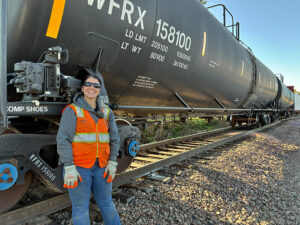 Toni Colton is a conductor with Ellis & Eastern, and she doesn’t have passengers to deal with: she’s building trains. Every day, Colton ensures the cars are filled and lined up so they can be delivered to her customers in the Sioux Falls area. She runs all types of aggregates from Knife River’s Madison Street plant to distribution yards within the Knife River footprint in Sioux Falls. Additionally, Ellis & Eastern hauls concrete sand from the KRC sand plant in Corson, S.D., to distribution yards at the Madison Street and Rice Street locations. Toni also has external customers who send her their rail cars to be organized and delivered every day.
She’s like a traffic conductor, only instead of cars and people, Colton is in charge of making sure her engineers – the railroad employees running the engines – know where they’re going, what they’re grabbing, and that they’re doing it all safely. It’s like a giant game of Tetris – with 130-ton railcars as the blocks – but she loves it.
“Looking back, I wish I would have started at the railroad way sooner,” said Colton, who has been with Ellis & Eastern for five years and in the rail industry for eight years. “I don’t want to do anything else.”
Colton grew up wanting to be a detective, and went to college for a degree in forensics investigations. Jobs on the police force were hard to find, so a friend told her to apply at BNSF because it had its own police force. There were no police openings at BNSF in her region at the time, so they hired Colton as a conductor.
It wasn’t always easy. After getting hired at BNSF, Colton attended a six-week conductor school to learn the job, which includes what feels like several different languages: spoken, signage, and hand signals. She had to learn how to communicate with other conductors and railroad personnel to know which tracks to use, what cars are coming her way, and who else might be on the track. Then there’s the train horn, which operates like Morse code to let other trains – and vehicles on the streets – know that her rail cars are coming. There’s also signs along the track that indicate who owns the track and which tracks are open to other rail cars, as well as hand signals to the engineer when she’s on the side of the track to let them know when to stop and how far they have left to go before they get to the car.
While she was learning her new career and all of the various codes that come with being a conductor, Colton was also navigating the additional challenge of being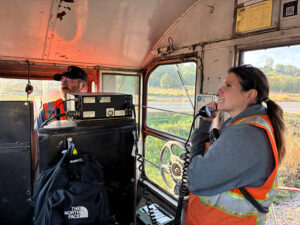 a female conductor in a job historically held by men. Women make up between 5 and 10 percent of train conductors across the country, and not everyone saw her as an equal on the job when she first started.
“I’ve had to work harder to prove myself (because I’m a woman),” she said. “I’m out there slinging sledgehammers just like everybody else. I’m not going to lie; it wasn’t easy when I started, but I wasn’t going to let anybody know that.”
As Colton learned the ropes of being a conductor and the ins and outs of the railroad, she also learned how to deal with the naysayers. Now, she’s in charge – taking calls on the radio from across the country to line up rail cars, keeping her team up to speed on the plan for the day, and ensuring everyone’s cars get where they need to be on time.
“I became a little bit more stern. People say I’m a little bossy, but it’s because I have to be,” Colton said. “Now I’m at a place where I know exactly how to do my job here and everyone will come and ask me ‘what’s your opinion on this, how do you think we should do this’.”
After three years at BNSF, Colton was furloughed. She saw an open position at Ellis & Eastern in Sioux Falls and applied. She thought the move from Omaha to Sioux Falls would be temporary, and that she’d head back to BNSF when her furlough was over, but that never happened.
“After a few months I realized I wouldn’t leave,” she said. “At BNSF I was on call 24-7; you could get a call and have to hop on a train at 2 a.m. I loved that – I didn’t know any different. At E&E they value family time and work-life balance.”
That work-life balance became even more important eight months ago when Colton and her fiancé, Thommy Allison – the quarry manager at Knife River South Dakota – welcomed their daughter, Livvy, into the world. Colton may be at work by 5 a.m. every day to get the day’s paperwork printed and set up her team for the next 10-12 hours, but she’s home in the afternoon, and weekends are for family time with Thommy and Livvy.
While Colton admits it’s easy to love the job on 70-degree days in the spring and fall and throughout the warm summers in South Dakota, she says the brutal cold and wind in the winter can be tough. Even with the weather and the long days, Colton says she can’t imagine doing anything else.
“I couldn’t sit in an office,” she said. “I never have. I absolutely love my job on (nice) days. Even the rain doesn’t bother me.
“Everyone thinks railroad is so cool; we probably take it for granted because we do it every day.”